+971 42473777
 By
By Whenever you learn something important, you naturally write it down somewhere or make digital notes on your phone.
But have you ever wondered why we write things down instead of memorizing? It is to keep your mind clutter-free and active. Writing allows your brain to process information much faster.
This is exactly what writing assignments do for you. It bridges the gap between textbook theories and real-world practices by pushing learners to analyze complex concepts. Hence, they are a core part of education at every academic level.
Let’s explore the real meaning of assignment writing, its purpose, benefits, and types to take a deeper look.
What Is an Assignment?
In simple words, an assignment is a piece of writing or a document that contains useful information. This information can be a part of your studies, job tasks, or official responsibilities.
Definition of an Assignment:
In academic terms, an assignment is a common task designed by teaching professionals to help students practice, implement, and demonstrate their understanding of key learning objectives.
Instructors expect students to demonstrate how much knowledge they gained from classroom lessons and how well they make use of that information in practical scenarios, be it professional or personal. They also assess our capabilities to work with informative material independently, without seeking professional guidance.
You will find assignment writing in almost all educational levels. From primary schools to PhD-level study programmes, assignments are a core aspect of learning. A few things that can be different are writing format, referencing, and complexity level.
Here is how an individual assignment influences your learning:
- You cultivate basic skills, including critical thinking, independent research, information synthesis, and time efficiency.
- You review classroom resources and present them in your own words. This also improves your memorization power and subject command
- You let examiners evaluate your learning progress and receive personal feedback. This way, you also find the learning gaps in your understanding.
Uses of Assignments at Different Levels:
This table gives a general overview of the common assignment types across major educational levels, their roles, and learning goals.
| Academic Levels | Goals | Common Types | Roles |
| Schools | Introduce study habits, practice daily lectures, and understand basic subjects | Daily homework, worksheets, short essays, basic report writing, and group projects | The purpose is to encourage a proper routine life with maximum study hours. |
| Colleges | Tests analytical capability, develops strong arguments, and applies the right methodology | Literature reviews, laboratory reports, case studies, expository essays | Understand the core educational structure, supporting claims with relevant sources and evidences |
| Universities | Promote independent and original research, professional intellectual skills | Dissertations, theses, bibliographies, advanced research projects, Reflective essays | Contribute new information and intellectual ideas, conduct advanced research on classical theories |
What is Assignment Meaning in Education?
Assignment is like the backbone of any subject. It supports education by pushing students towards actively engaging in diverse coursework. Assignments also encourage students to shift from rote memorization into critical thought and develop a deeper perspective of what they learned.
What Does Assign Mean?
The verb “assign” means to intentionally give a particular task, duty, or responsibility to an individual that serves a real purpose.
For an educational setting, it simply means the teacher wants students to complete a specific topic-oriented work within the specified time. It can be an essay, reading, or a project.
Assigning Work vs. Completing Assignments:
These two actions represent the two sides of the same coin:
- Assigning work: This is done by the educator. It requires them to design learning goals, discuss the general guidelines, and designate doable tasks to students.
- Completing Assignments: It is the responsibility of students to act on the tasks. They must manage their time to explore information without seeking help from peers. The work demonstrates how students have organized their thoughts, gathered ideas, and transformed them into an “A” grade assignment.
Role of Assignment in Education
The role of assignments is valuable and different in the educational dynamics of primary schools, high schools, colleges, and universities. The initial focus is basic learning, which later shifts according to the student’s academic maturity level.
1. Primary and Secondary Schools:
- Daily homework and classwork ensure that young minds regularly practice and understand key topics in essential subjects like grammar, mathematics, and science.
- All forms of assignments give exposure to different kinds of critical evaluation and teach self-discipline.
- It fosters parental involvement as they are required to monitor their child’s learning progress. This builds a strong child-parent relationship.
2. Undergraduate and Post-graduate Institutes:
- Learners are upgraded to more advanced and challenging study modules. Instead of rote memorization, you need to discuss your own thoughtful ideas.
- Through long dissertations, technical lab reports, field surveys, and case studies, university projects assess learners’ creativity in relating original theories to real life.
- Journals, term papers, and field projects that require formal writing and a structured referencing style prepare students to pursue professional careers.
Here are the three main learning features that make up the overall academic framework in all educational levels:
- Assessment: It is a practical evaluation designed by teachers to track students’ knowledge of coursework topics over the semester. With these findings, teachers can identify what their students lack and provide constructive feedback.
- Learning Reinforcement: To complete assignments, students interact with different study materials, which solidify long-term understanding. It also prepares them for annual exams with diverse questions and think-tanks.
- Academic Growth: All types of assignments bring value to learners. Some enable students to analyze technical information, while the rest teach them to form well-reasoned summaries. They learn to solve difficult scenarios independently. They also develop written communication and unique research methodologies, which are great for future careers.
What is the Purpose of Assignment?
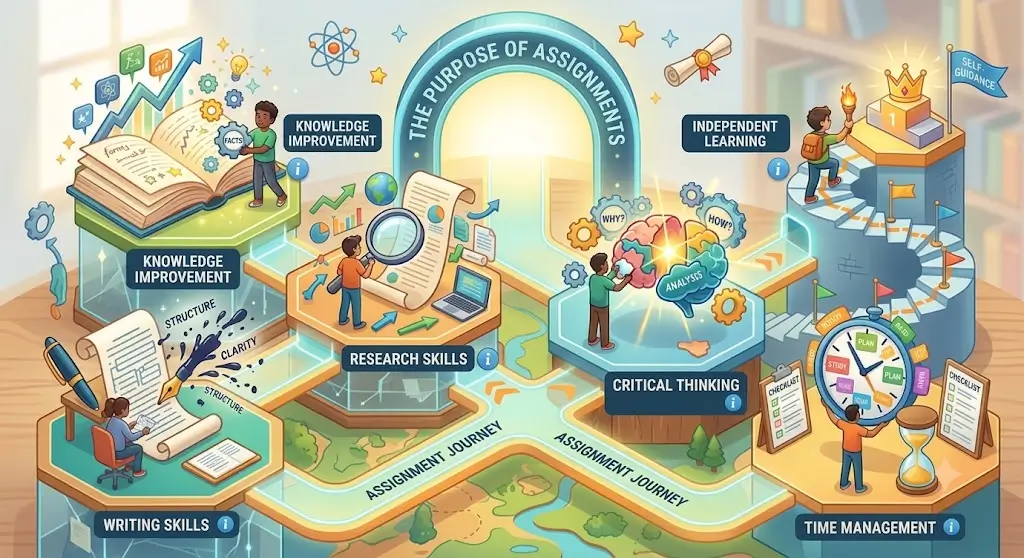
The main purpose of an assignment is to expand a learner’s knowledge of a subject. Therefore, the several benefits of assignments correspond to each purpose.
Knowledge Improvement:
Reviewing classwork at home lets the student memorize information for the long run. Most assignment questions require students to write answers in their own words. This builds active understanding of the subject. Students are able to outline what is covered and what needs to be studied more.
Research Skills:
Students learn how to gather information from textbooks and databases. They also evaluate the difference between known facts and personal opinions. Long essays or dissertations allow students to compile multiple sources into a strong piece of writing.
Writing Skills:
Regular writing helps learners to express their thoughts in simple and meaningful sentences. Students learn to organize their arguments logically with essay and report writing. They also get to know the use of informal and formal vocabulary in professional writing.
Time Management:
With assignment deadlines, students are able to track their learning pace, which is useful in professional careers. They learn to divide big projects into smaller tasks and also prioritize the difficult tasks. They also develop work discipline by managing several assignments at once.
Critical Thinking:
Working on different types of assignments and a diverse range of topics develops critical analysis of a situation in students. With difficult prompts that require information comparison and evidence-based judgments, students learn to evaluate theories with different reasoning.
Independent Learning:
By writing assignments on their own, students develop self-study habits rather than depending on spoon-fed information by teachers. Working alone on challenging projects creates determination.
Most Common Types of Assignments
As we discussed above, different assignments serve different purposes; they typically range from concise and simple essays to lengthy and complex projects.
Essay Assignment:
- Essays are mostly required across disciplines like humanities and social sciences.
- Written for the academic community, the goal is to explain and argue persuasively on a focused area of study.
- The evidence-based statements should be relevant and concise.
- They must be written in a formal style of writing and active voice in a logical paragraph flow.
- They don’t require many headings except for three main headings: assignment introduction, main body paragraphs, and conclusion.
Term Paper:
- It is a detailed, research-backed academic assignment required to be submitted at the end of a term.
- Its main purpose is to examine a student’s understanding of the course curriculum and their skills to work out independent research and present strong opinions.
- The length of the paper ranges from 5 to 20 pages, which makes up a major portion of the final grade.
- The students are required to gather information from outside sources and literature reviews for data analysis to support a central idea.
Dissertation:
- It is a lengthy and research-backed formal document typically required in doctoral degrees to demonstrate independent investigation of the student.
- The goal is to contribute entirely new information to the relevant field.
- The structure follows a general introduction, literature review, methodology, findings, and final judgement.
- It doesn’t end with the submission. The students have to prepare for an oral presentation to provide arguments in defense in front of the academic committee of the university.
Case Study:
- It is mostly required in subjects like business, healthcare, and law where we apply strong reasoning.
- A case study is a comprehensive examination of a specific event, problem, or situation that involves students’ recommendations and practical solutions.
- The aim is to collect and present valuable knowledge to demonstrate what and why a certain thing happened.
- The writing pattern includes numbered headings and subheadings, a table of contents, and a summary.
Report:
- Writing a report involves investigating clinical or statistical information, analysing lab experiments, and interpreting data from an issue or a situation.
- Students are required to give proposals or personal suggestions on the basis of analytical findings.
- Reports have several sections and subsections depending on the topic requirement and length.
- These documents include an abstract section, a table of contents, and bullet points.
Reflective Journal:
- The purpose is to find out the level of a student’s knowledge and understanding of a specific topic, event, or experience.
- It requires you to demonstrate your action plan, which you think of after learning theories and complex concepts.
- The mode of writing is description, reflection, theory linking, and an actionable plan.
- The writing style should be conversational. Also, use first person.
Thesis:
- It is typically required to be submitted at the end of a master’s program or a capstone project based on the student’s original research.
- It examines a student’s ability to understand complex topics and theories and present them with their personal opinions and suggestions in a long document.
- It features a research problem, the methodology and practical applications used to gather data, data analysis, and observations.
- Students are required to discuss claims in front of an academic committee to support their ideas.
How to Plan Your Assignment?
Planning your assignment is very easy if you follow a logical sequence and the academic guidelines of your educational institute. Students must allocate sufficient time for research, outlining, drafting, and editing the assignment.
The Standard Assignment Format:
To ensure proper academic criteria are followed, break your entire project into the following sections in the exact order:
- Cover Page: This is the front page of the document, which has the student’s name, ID, email, course title, assignment title, teacher’s name, and deadline.
- Title: This is a clear sentence that is the essence of your topic. It is placed at the top of the cover page.
- Introduction: This part gives the background information of the study. It also defines the scope of the topic and clearly states the main argument.
- Body: Based on several paragraphs, headings, and subheadings, students write evidence-supported ideas and opinions to demonstrate their research and understanding of the main topic. It also includes data analysis and findings to support your claims.
- Conclusion: This part summarizes all the main points and restates the essay with a new approach. It also shows the learner’s final judgement.
- References: This is an alphabetically sorted list of all sources cited in the writing and formatted according to the required referencing style of the academic standards. The style guides include APA, MLA, or Chicago.
The Proper Assignment Structure:
It is very important to follow a proper structure in your assignment. It ensures your thoughts are well understood and academically fluent.
Make sure you use the following structural frameworks in your writing:
- Logical Flow: It is essential to maintain the text in cohesive paragraphs. Each paragraph must be well-organized and transition gradually into the next without jumping to a new idea.
- Prominent Headings: Include clear headings and subheadings in a sequential format such as H1, H2, H3, and H4. This way, you divide the dense text into a reader-friendly guide.
- Citations: Don’t forget to mention the intellectual minds behind all borrowed ideas, quotes, and sources. It also prevents plagiarism. Students must use in-text citations within the main body that correspond to the reference lists.
- Formatting Guidelines: Ask your instructor or read your institution’s regulations regarding margins, line spacing, font style, and font size.
Do you want an expert’s help to understand the referencing requirements in your assignments? Don’t worry!
Whether you need to do heavy research or link in-text citations in the body paragraphs, you can get your assignments completed before the deadline.

Distinguishing Between Homework & Assignments
Though some students treat both homework and assignments similarly, there’s a drastic difference between the two. Both are essential learning tools in a student’s educational journey.
To give you a clear overview, the table below features the main differences between homework and assignments:
| Type of Work | Homework | Assignment |
| Duration | Regular tasks | Weekly or monthly/depending on the academic level |
| Focus | Daly Practice | Research-based |
| Length | Short | Longer |
| Grading Weight | Not significant | High grading |
| Work Nature | Repetitive | Critical approach |
Comparing Homework vs. Assignment:
- Purpose: Homework only helps students practice and recall daily concepts. Assignments test students’ judgement to link learned ideas to new situations.
- Difficulty Level: Homework is generally simple and easy to solve. It requires students to repeat specific methods taught in class lectures. The assignment is lengthy. It requires critical analysis of the original ideas.
- Length: Homework is brief and only takes 30 minutes to an hour to be completed, depending on your grade. Assignment takes several days or weeks to finish.
- Assessment: The grading for homework doesn’t matter, as it’s just for practice and to get the teacher’s feedback. Assignments carry more weight. It contributes to the term’s progress.
Tips for Writing a Meaningful Assignment
Follow these practical tips to earn the highest grades in your assignments:
- Read instructions carefully: Always understand the assignment topic carefully and emphasize words such as analyze, discuss, explore, and explain to figure out what the teacher has asked.
- Manage Time: Break down your assignment into easier, doable sections. Also allocate the most time to the difficult tasks to ensure the assignment is completed before the due date.
- Write an Outline: Jot down all the headings and subheadings that you want to include in your body.
- Quality Research: Search local public libraries and online websites or databases for reliable information.
- Mention Trusted Sources: Ensure the ideas you’ve taken from belong to reviewed articles and authorized websites.
- Plagiarism Run: Test your document against digital AI tools to detect plagiarism. This is an important step to ensure your work is original.
- Proofread and Edit: Read your entire document word by word to spot any grammatical mistakes or incorrect vocabulary before submitting.
Wrap Up!
The role of assignments in education is greater than students usually expect. It teaches them to work independently, develop a valuable understanding of core subjects in their chosen field of study, and critically evaluate theories and concepts to present personal opinions. Assignment examples like business case studies or legal thesis writing build a student’s credibility. By following useful assignment writing tips, correct referencing style, comprehensive research, and formatting, it is guaranteed that you will ace your academic term.
Frequently Asked Questions (FAQs)
1. Can I write my assignment in two days?
Yes, you can. You need to stay focused and use a structured approach for completing assignments like essays or reports within two days. Students can do this by dividing their time strictly between outline planning, writing, proofreading, and editing.
2. How do students benefit from an MBA dissertation?
By writing an MBA dissertation, graduates learn how to implement business management concepts into real-world scenarios.
3. Is homework easier than an assignment?
Yes, homework is easier than an assignment because it’s brief and given daily. Students are required to complete tasks related to classroom lessons.
4. Is college homework and school homework the same?
No. Both are based on regular classroom lectures, but the scope is entirely different. School-level homework follows basic academic criteria, which is very easy. However, in college, students are required to learn difficult and in-depth concepts. Therefore, college homework is difficult.
5. What does an assignment mean?
It is a piece of writing submitted by a student to demonstrate their understanding of a difficult topic.
6. Can I skip the reference list in my assignment?
No. It guides the reader to where the in-text citations are borrowed from. Without an orderly reference list, it may confuse the examiner. Therefore, students can negatively impact their grades.
7. What is the difference between APA and Harvard?
Both are author-date referencing styles. But the main difference is that Harvard is used across universities in the UK, Canada, and Australia. APA is mostly for American universities.
8. Can I hire someone to proofread my assignment project?
Yes, it is an ideal strategy for busy students to let a professional assignment writer handle proofreading and editing.
9. What is the Chicago style?
Chicago is a commonly used referencing style that has two different systems. Bibliography in the humanities and author-date for sciences and social sciences.
10. Can I use ChatGPT for my assignment?
No, it is against university standards. However, you can use it to get inspiration for general prompts and ideas.
11. Is it possible to write a thesis in a week?
Yes, you can write a thesis in a week depending on your subject and work-life balance.
12. What happens if you fail a dissertation?
You may get a chance to resubmit it within a specified due date.